


On this page
In January 2026, about 171,000 people held a tokenized stock. By the end of September, more than four million did. Few corners of finance have grown that fast, and most broker-dealers have not yet looked closely at what is being built.
This briefing is for them, and for the trading and DeFi operators who sit alongside them. It maps who does what in tokenized stocks today, explains the two models for putting a stock onchain, and asks the question that will shape the next phase of the market: as more tokenized stocks launch, who holds the shares behind them?
Most of what we have published so far has covered private assets, from how private assets become tokenized investment products to why DeFi now needs real assets to curate. In April we argued that emerging markets are the next frontier of tokenization, starting with listed assets. This piece turns to public markets and the firms that will carry them onchain.
Nine months, twenty times the holders
The numbers explain why the question now matters. According to RWA.xyz, holders of tokenized stocks rose from about 171,000 in late January 2026 to 3.51 million on 14 September and 4.04 million on 29 September, up by more than 60% in thirty days. The market now spans more than 7,600 tokenized instruments.
Read figure 1 as text
Area chart. Holders of tokenized stocks rose from about 171 thousand in late January 2026 to about 2.46 million at the end of August, 3.51 million on 14 September and 4.04 million on 29 September 2026, roughly 23 times more in nine months.
Value has followed. Tokenized stocks were worth about $344 million in August 2025. They closed 2025 near $1 billion, after growing 128% in the second half of the year, and reached $2.54 billion in August 2026, more than seven times the level a year earlier. By late September, the ten largest platforms together held about $3.1 billion. Data providers measure the market differently, and some report lower starting points, but all show the same steep curve.
Read figure 2 as text
Bar chart. The value of tokenized stocks grew from about 0.34 billion dollars in August 2025 to 0.91 billion in January 2026 and 2.54 billion in August 2026, more than seven times in a year on a like-for-like basis, and to about 3.1 billion across the ten largest platforms in late September 2026.
These are still small numbers next to global equity markets. But the curve matters more than the level. A market that grows sevenfold in a year and adds millions of holders in a quarter stops being an experiment and becomes a distribution channel.
Who does what in tokenized stocks
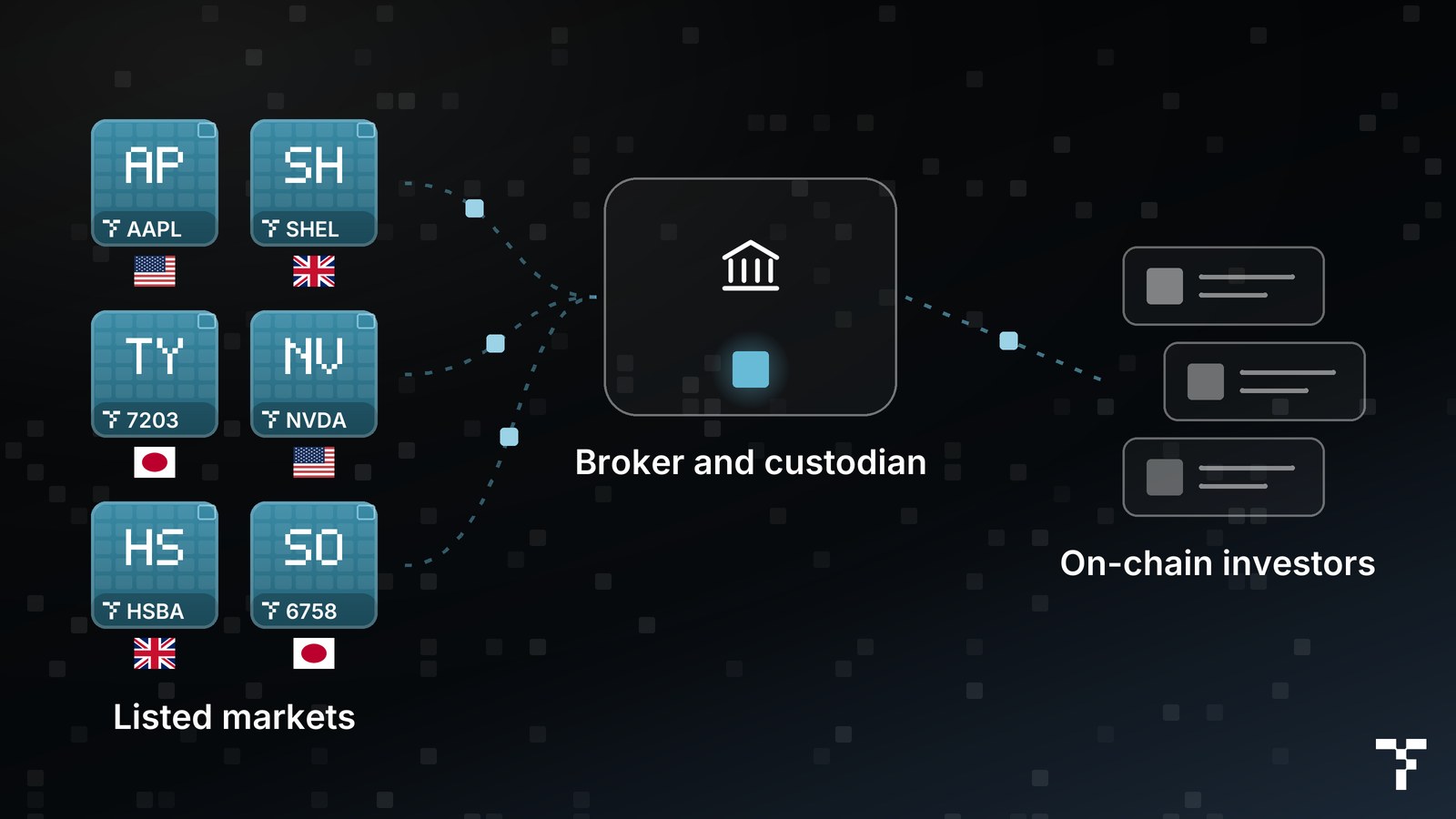
Tokenized stocks involve four groups of firms. Issuers create the tokens. Brokers and custodians buy and hold the real shares behind them. Venues, from crypto exchanges to DeFi protocols, are where investors trade. And networks such as Solana and Ethereum carry the tokens themselves.
Read figure 3 as text
Four stacked layers. Issuers such as Ondo, Binance bStocks, Kraken xStocks, Robinhood, Securitize, Superstate and Dinari. Brokers and custodians that hold the real shares, where Alpaca reported more than 94 percent of tokenized US stocks in December 2025 and exchanges now add their own. Venues including crypto exchanges, DeFi protocols, broker apps and new US onchain venues. Networks including Solana, Ethereum, BNB Chain, Arbitrum and Base.
The issuer layer is already crowded, and it includes some of the largest names in crypto. On 24 September, Ondo led with about $867 million, followed by Binance's bStocks and Kraken's xStocks. Together, the top three held about 70% of the value of the ten largest platforms. Binance only launched bStocks in June 2026, and it overtook xStocks within weeks. Robinhood issues tokenized stocks to customers in Europe, and firms such as Securitize, Superstate and Dinari are building on the US side.
Read figure 4 as text
Horizontal bar chart. Ondo 867 million dollars, Binance bStocks 745 million, Kraken xStocks 571 million, Securitize 456 million, Reality 157 million, Robinhood 149 million, Figure 83 million, Superstate 37 million. The top three hold about 70 percent of the value of the ten largest platforms.
The custody layer is the opposite: it is highly concentrated. One US broker-dealer, Alpaca, reported in December 2025 that it held the shares behind more than 94% of tokenized US stocks and ETFs. Newer entrants are now building their own: Binance's bStocks buy the underlying shares through the group's own broker entity, according to its launch announcement. When the first issuers looked for a broker willing to support them, few established firms took the business, and the one that did became the default for much of the market.
Two ways to put a stock onchain
Behind the brand names, there are two basic ways to put a stock onchain.
Backed tracker notes. This is how most of the market works today. An issuer receives cash or stablecoins from an investor, buys the real share through a broker, and holds it in a separate account. It then issues a token, legally a note or certificate, that tracks the share one for one. The investor gets the price, and usually the dividends, of the stock, without owning the share directly. Because the issuer can buy any stock its broker can reach, this model works for any listed market. It is mostly offered to investors outside the United States.
US native tokenized shares. Here the token is the share itself. A regulated transfer agent, the firm that keeps a company's register of owners, records the holder onchain. A small number of companies already work this way. On 17 September 2026, the SEC issued an Innovation Exemption that lets approved venues trade tokenized US stocks onchain for five years while permanent rules are written. It is the most native model available. It is also limited to US-listed stocks, and according to Sidley Austin's analysis, its relief covers venues and liquidity providers, not the firms that tokenize or hold the shares.
Read figure 5 as text
Two flows side by side. Backed tracker notes: the investor pays in cash or stablecoins, the issuer buys the real share through a broker, the broker holds it one for one for the issuer, and a token is issued that tracks the share, in any market a broker can access. US native tokenized shares: the company's shares are registered as usual, a transfer agent records the owner onchain, the token is the share itself, and it trades on approved venues for US-listed stocks only.
The two models side by side
Neither model is simply better. They solve different problems, for different investors, in different markets.
| Backed tracker notes | US native tokenized shares | |
|---|---|---|
| What the holder owns | A note that tracks the share, backed one for one by real shares | The share itself, recorded onchain |
| Who holds the real shares | A broker-custodian, in an account kept separate for the issuer | The company's register, kept by a regulated transfer agent |
| If the issuer runs into trouble | The shares are kept apart for noteholders; protection depends on the structure | The holder owns the share directly |
| Dividends and votes | Dividends passed through; the vote usually requires redeeming for the share | Generally as for any registered shareholder |
| Who can buy | Mostly investors outside the US | US investors, through regulated venues and brokers |
| Which markets | Any market a broker can access | US-listed stocks only |
| Adding a new stock | Fast: any listed stock the broker can buy | Slower: needs issuer or venue set-up, and issuers can object |
| Where it trades | Crypto exchanges, DeFi protocols and broker apps, often around the clock | Approved US onchain venues |
Table 1. The two main models for tokenized stocks, simplified. Individual structures vary.
The US native model offers the cleanest form of ownership, for one country's stocks. Backed tracker notes offer reach: any market, any investor outside the US, as long as a regulated broker holds the shares one for one. Both need a firm that holds or records the real shares. That is where the market's real bottleneck sits.
The question behind every token
Every tokenized stock depends on a regulated firm that holds the underlying shares, confirms they are there, and supports the creation and redemption of tokens against them. As the number of tokens grows, investors and venues are starting to ask who that firm is.
For a broker-dealer, that role brings three things:
New assets. Market makers are starting to create tokens from shares they already own. When Ondo introduced this option in September, it worked by moving shares between accounts at the same broker. Shares move toward the broker that supports creation.
New clients. When a holder swaps a token back for the real share, that share has to land in a brokerage account. Onchain investors become brokerage clients.
A trusted name. As tokens multiply, investors will choose between similar products by asking who holds the shares behind them. A recognized custodian becomes a reason to choose one token over another.
Tokens only hold their value when the shares are really there. In June, tokenized pre-IPO allocations sold on several exchanges were cancelled on listing day because the shares never arrived. The firms that can prove one-for-one backing will set the standard for everyone else.
The other half of the world's markets
Estimates vary, but roughly half of global stock market value sits outside the United States. The new US exemption does not reach it. Tokyo, Frankfurt, Hong Kong, London, São Paulo, Johannesburg and dozens of other markets are open to onchain investors today only through backed tracker notes, and the custody capacity behind those notes is still thin.
Read figure 6 as text
A half-ring split roughly in half: the US on the left, reachable under the new US exemption and through backed notes, and the rest of the world on the right, reachable today only through backed notes. Beside it, example markets outside the US: Tokyo, London, Hong Kong, Shanghai, Frankfurt, Paris, Toronto, Zurich, Seoul, Sydney, São Paulo, Johannesburg, Riyadh and Amsterdam.
This is the larger opportunity. A broker with direct access to many exchanges already has most of what the market needs: execution, custody, and relationships in local markets. What it lacks is the connection to onchain issuance and distribution. The brokers that make that connection will become the gateway for every market they already cover. That is why the next phase of this market will be decided by coverage, not by any single country's rules.
Why now, and where T-Blocks is going
A year ago, a broker could reasonably wait. Today, four million holders, several billion dollars, a US regulatory path and the largest crypto exchanges are all in the market. The first movers have already moved. For everyone else, the question is how to take part without taking on risks outside their core business.
That is the question we set out to answer. We believe the world's public markets will come onchain, and that the markets outside the United States will be the larger story. T-Blocks is building the regulated layer that brings listed stocks from those markets to onchain investors, backed one for one by real shares.
We are building it in partnership with established broker-dealers, not around them. Brokers bring market access, execution and custody. We bring the regulated structure, the technology that connects shares to tokens, and the onchain distribution. Together, that is how a stock listed in any market can reach an investor anywhere, at any hour.
The pace of this market leaves little room to wait and see. If your firm holds the world's shares, we would like to talk.
Explore the next rail for listed markets.
Public Assets is coming soon. Follow the launch or discuss your use case.
Keep reading.
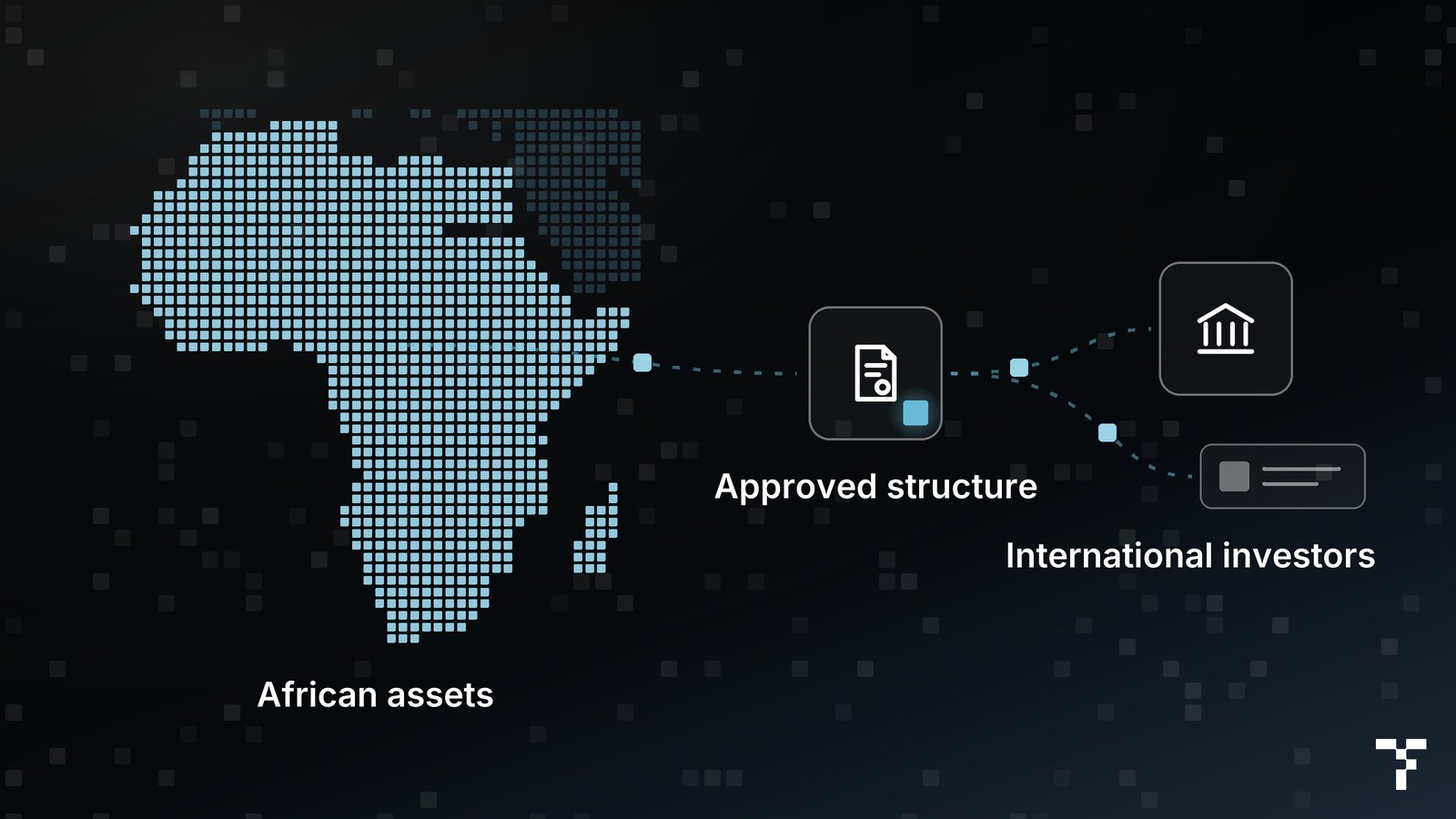 Market signalsAfrica’s yield is real. The infrastructure to access it is missing.International investors are not short of interest in African assets. They are short of structures their compliance teams can approve.
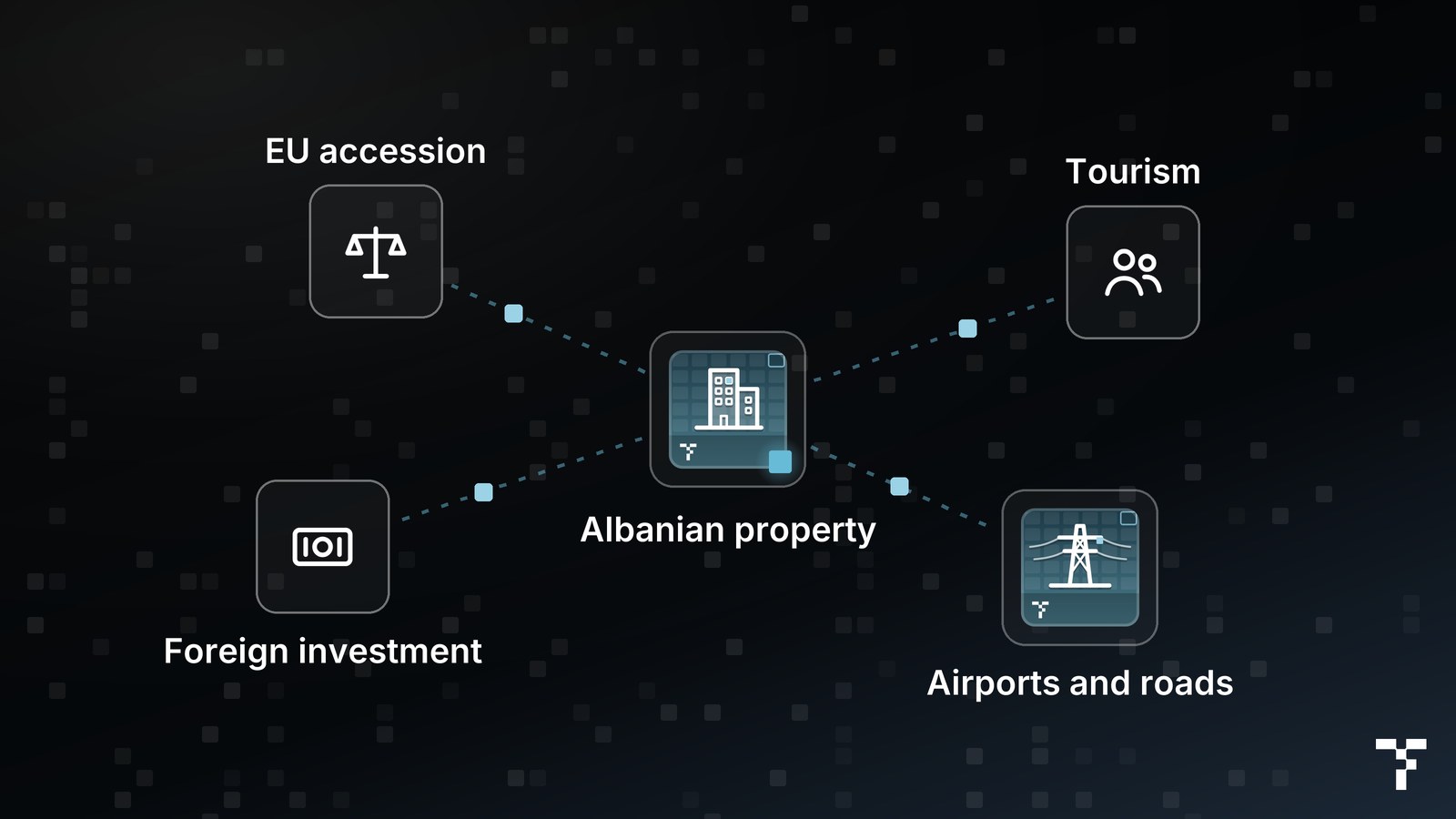 Market signalsIt’s Time to Diversify Your Investments! 3 Reasons Why Albania Is Leading Emerging Market GrowthTourism, new airports and roads, and record foreign investment in the first half of 2024 as drivers of Albania's property market, plus EU accession.
 Market signalsEmerging Horizons: Albania and the Balkans Leap Towards EU Integration and Economic PotentialWestern Balkans growth, the EU Economic and Investment Plan, Albania's entry into the Single Market Programme, and Croatia's EU path as a regional model.